Welcome to Weather-Above

Use the Reload or Refresh facility on your browser to retrieve the latest data.
The position of the sun in the sky changes through the day, reaching its highest point around midday. This means that the ultraviolet radiation is strongest at that point in day. The rise and fall is fairly steep:
The peak daily ultraviolet radiation level changes over the year. The strongest being at the Summer solstice (21st June) and the weakest at the Winter solstice (21st December).
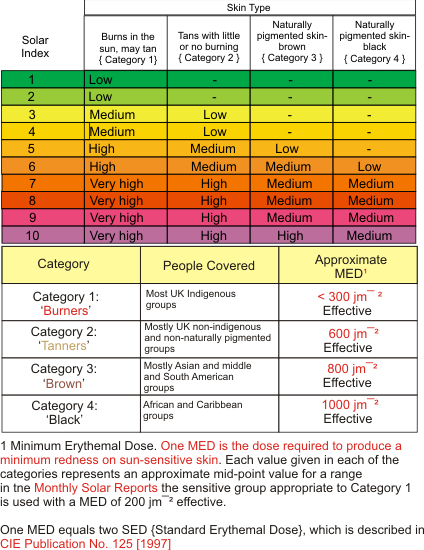
Cloud cover however, will greatly affect the uv index. Thick cloud can greatly reduce ultraviolet radiation levels and, surprisingly, certain types of thin cloud can magnify the ultraviolet radiation strength. It is the job of meteorologists to take the documented ultraviolet radiation level for a particular day in the year, and then taking into account the cloud cover forecast, make a prediction of how strong the ultraviolet radiation at ground level will be - this will be the sun index.
Forecast based on clear sky

Weather data is based on amateur readings and should not be interpreted as being totally accurate.This site is just for people with a general interest in weather
Important note Due to our earthquake monitoring the time zone was changed to UTC this was started on 24/03/2010

Hobby board Solar
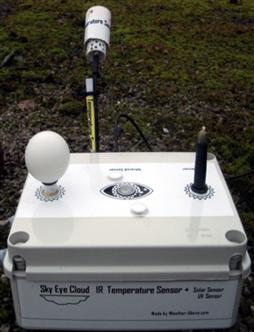
UV and solar sensor graph, data is coming from (weather-above sky cloud sensors + add-on modules )
weather-above sky cloud sensors